
Introduction
Exploring ancient trackways on foot in the landscape is a delightful way to make a connection to the land. This is a different activity than forest-bathing. It focuses more attention on the whole of the landscape. It is an active walking exploration of a pathway or trackway. And it is another way of becoming EarthWise.
Learning the land is not always an immediate process. Sometimes it just takes time. It takes time to understand what is not immediately apparent to the single sense of sight. Rather, it is a chance to engage all of the senses. Exploring the changes to the land change as the weather changes, change as the seasons change. A wood under the summer sun is far different than the same wood under a winter full moon.
The benefits of exploring on foot
The benefits of exploring ancient trackways on foot are immediately noticeable. The feel of land is of course related to how you traverse it. You get differing views by car or by train. The world is a streak of green, of grey, of valley and hills, and anonymous seeming stretches of trees. Slower, by cycle, there is a more intimate connection with the land.
And exploring by foot gives an even slower, more intimate connection to the land. Climbing a hill on foot feels far different than on a cycle or on a car. In a car, the uphill trajectory of the road might not even be noticeable. But by foot, a long slow grade has a much different feel. The undulation of land becomes more noticeable. There is time to take in the views. There is time to not only see the landscape, but to become part of the landscape. You are no longer simply travelling through it as fast as possible. You are part of it, and the landscape becomes the reason for the journey and exploration. And the exploration becomes in itself a destination, of a deeper connection to land.
Exploring local history
Knowing something of the history of a location, then, helps in forming a connection. It also helps in understanding the roads, the byways and highways, that traverse it.
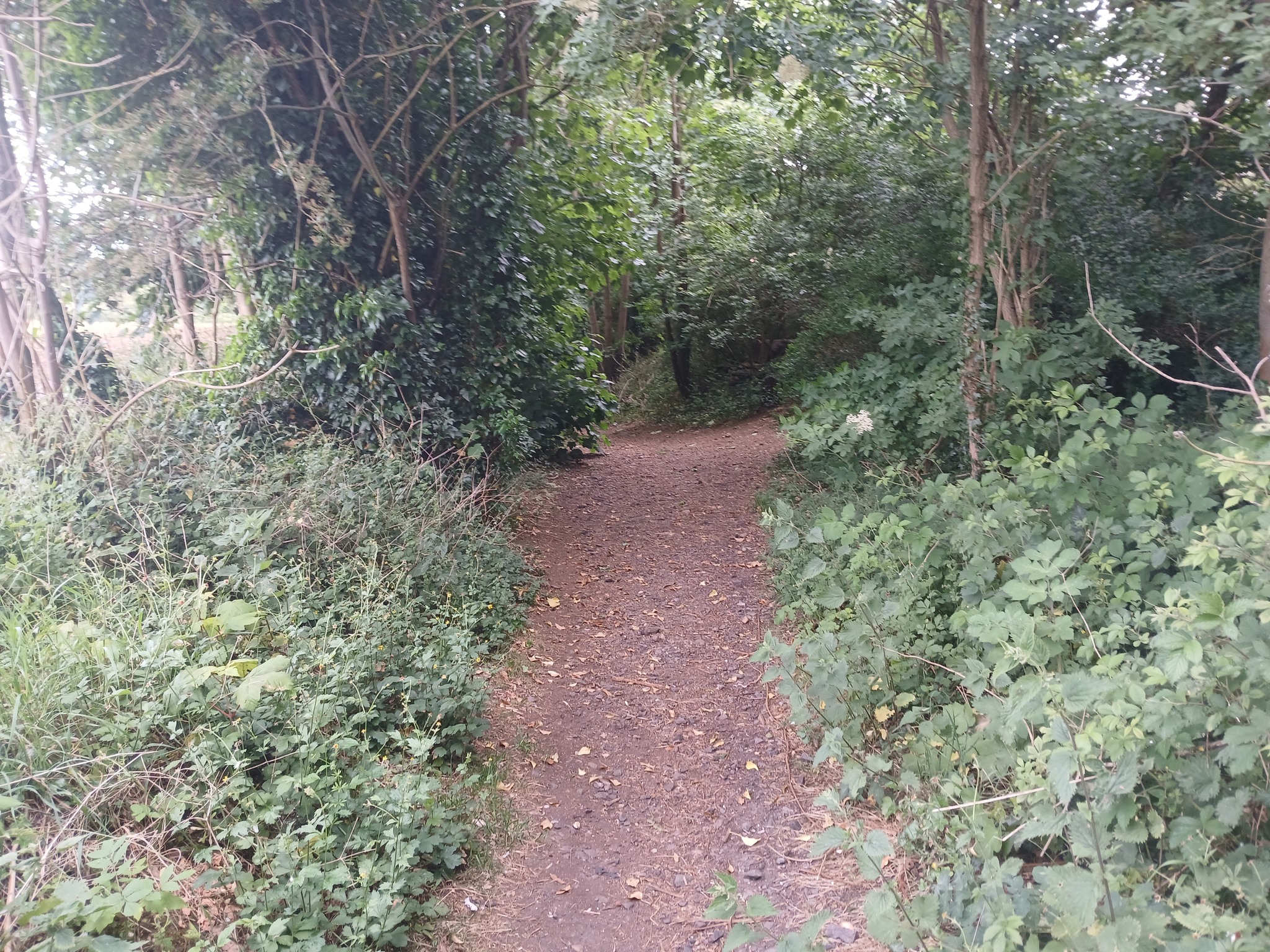
Local to me is a narrow footpath, barely noticeable from the road. There is a footpath sign, and a small suggestion of a path straggling up a hill. It flanks a a housing estate. It is in a curious place, just on the edge of busy roundabout. This suggests it was there long before the modern road. But why? It skirts rather than links the nearby villages.
It is nearly a wood that carries the name of “holloway.“ A holloway is an ancient track formed well before the time of Romano-Britain. It was used to drive herds of animals, and for general travel. Over time the land was worn down with steep banks developing on either side of the road.
This track formed an important connection to the Roman areas and settlements along the River Ouse and northward. The outlines of the road and still echo today amid modern housing and modern roads. There are well documented Roman finds just south of where the Roman Road begins from the modern road. It certainly makes sense that my Roman Road was indeed in use in the Roman times. What is less clear is whether it pre-dated the Romans.
Who walked the road before me?
When I walk, I like to imagine who might have walked here in the pre-Roman Days. When I walk, I like to imagine who might have walked here in the pre-Roman days. Were they pushing herds of sheep between pastures or between markets? Were they explorers? Is the wood that now flanks the road old enough to have been there in the Bronze or Iron Age? Or is it a recent addition from the Victorian times? Are the pitched banks the remnants of the holloway? Or a more recent configuration? Information on my road is hard to find.
So I let my imagination fill in the gaps as I walk on what I have named the Roman Road. It does not seem to have any other name or label to identify it. And so the Roman Road it is, even if technically speaking, it is a holloway and not Roman.
A surviving fragment of a bigger network
I see how my portion of the road leads north from the River Ouse, north into other lands. This leads into what would become the Danelaw portion of England. I will write more about the Danelaw influence in a future post.The Danelaw is much more recent than the time periods I imagine as I walk the road.
No doubt there was a continuation of the road south of the river along what is now a disused canal, down into the area where many of the Roman finds have been made. So what remains of my road is a fragment, not the beginning or the end of it, but some unremarkable middle portion that has somehow survived the centuries.
And that in itself seems remarkable– that this half-mile or so stretch of what is now a muddy footpath has survived at all across time. That is worth noting, worth acknowledging, as I slowly traverse the path, noting how it follows the contours of the land, a shift to the left here, a shift to the right there, before cresting on a flat field. In front of me, the horizon to the north stretches away, across clear and nearly flat fields. Perhaps in the pre-Roman days, those were not fields, were not clear of trees at all, and yet the view offered of the distant horizon from the hill would not have changed. The road would have carried on north– and that hill surely was a place where a traveller–whatever their purpose– would have paused to drink in the view and consider the journey that beckoned ahead.
An ancient track in modern times
And so it is I begin to learn the local land. Walking it slowly, in different seasons, at different times of day, all help in getting to know the stretch of Roman Road. I walk as people would have done for ages, beating the track into the earth so that it has survived, footfall by footfall. I research for what information has been documented, close my eyes and try to picture what is timeless about the road and the land around it.
Why did it survive– this one fragment– not paved over or ploughed under or built upon? Is it only mere chance or something else that helped its existence? Why north here after the river– the river crossing must have been a useful and manageable one at the time the road began to be used. Today the river is surely altered beyond all recognition, the course of its flow altered, a canal changing it as well– but way back when the road began to be formed, that particular area must have formed an attractive navigable ford. So in listening to the land and its stories, I can also begin to learn how the landscape has been changed by human hands over time.
Tuning into the land around me
These are the things I am learning as I connect to what is around me– as I begin to hear the tale of the Roman Road, of the slow churn of time and of those things that are somehow timeless. And in all of these ways, I begin to connect to the land. Being able to tune in and hear the slow story that the land has to tell– why, that is the biggest reward of all.