
Introduction
The journey to the ancient Roman Barrows, so softly folded into the landscape raise some specific questions for me about them, what their significance is, and why they might have been located in this particular location.
Getting to understand the recent and ancient history of the landscape is one way of becoming EarthWise. At some point in time, these barrows were significant to someone. They were placed at a particular location in the landscape for a reason. Today, the scant clues which can be uncovered by archaeology offer some insights. But as discussed in this blog post, there is always a great deal of speculation that goes into trying to weave together the story offered by the remaining bits and pieces of ancient spaces and places.
As with many places, questions arise—why? Why this place? And why this shape? What happened here? At what point was it no longer important and when did whatever specific significance it hold fade from memory and story telling?
The Roman Barrows, in that sense, are no different than many other ancient monuments on and now part of the landscape.
Once upon a time: imagining the past
Once upon a time these were significant, with a great deal of time and effort put into their creation. No less should it be imagined that a great deal of time and effort went into planning their location.
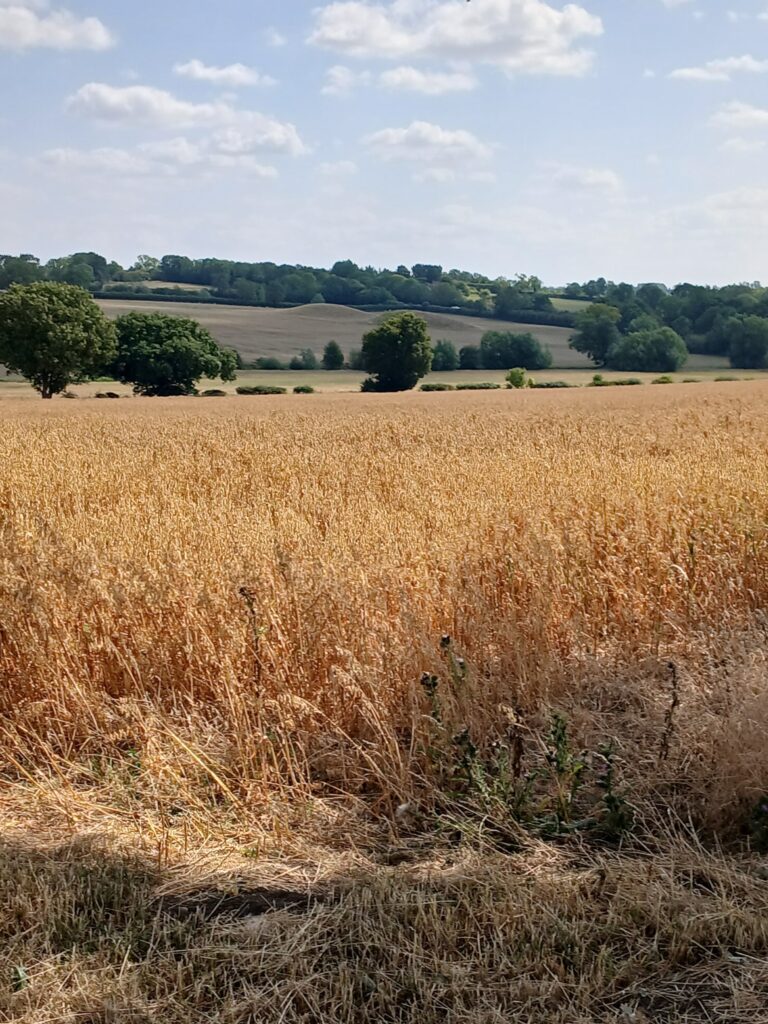
Which is something which gives pause in the present-day. For the barrows are in a somewhat non-descript field. Nor are they easily accessible. An A road thunders past, a road that is inhospitable to cycling or walking due to the lack of a verge and the heavy traffic along it. The barrows blend into the landscape. Unless you knew they were there, and planned to visit them, you would miss them altogether.
But this was not always the case. The A road is in fact on the line of a former Roman road. So a major road in Roman times went to where the barrows now lie. I would never have guessed the modern A road dated back to Roman times– but it does. And it is far from an isolated phenomenem. There are many modern built-for-car roads that follow the line of Roman roads.
Finding other clues in the landscape
Other than a major road in Roman times, are there other clues about why these barrows were located in this particular spot? Their location is also near a river, as well as the Roman Road. One possible interpretation offered is that the benefit of this location near a river and road is “so that the dead could be remembered as travellers passed by.”
If this interpretation is correct, then it only points out how busy this location was once. And how much this is changed. Few if any travellers would be aware of the barrows as they speed past them on the A road.
Interpreting the barrows
What is a barrow?
In its most general sense, a barrow is a human made burial construction. It is a deliberately built earthen mound, associated with the burial of human remains.
Barrows are first noted to have been constructed in the Neolithic era. They continued to be built in the Bronze Age, the Iron Age, and beyond into Romano-Britain and even Anglo-Saxon Britain.
But intriguingly, the Roman Barrows—as the very name suggests—are later were built during the years of Roman occupation of Britain. Archaeology suggests that these barrows were in fact constructed in the latter part of the 2nd century CE.
Were barrows still common in the Romano-British era? Why was a barrow constructed? Did that not hearken to a pagan belief of some sort rather than Christian? And this in turn begs the question of when Christianity became widespread in Roman occupied Britain?
Other Roman remains in the landscape
Is there other information which can be gleaned about and from these barrows? Nothing removes the speculation from the interpretations offered. Nothing is none for sure. And this is a common situation when trying to understand the material remains of the past.
There are, however, further interpretations available as to the significance of these barrows grounded in available information.
Excavations in the region of the barrows have turned up the remains of a Roman temple. This temple site is on the other side of the busy A road, just as it would have been on the other side of the Roman road in Romano-Britain times.
A picture in this article shows the way in which the temple may have looked.
There is speculation that the temple was “a shrine to a local river god.”
But other information suggests that the temple may have had a different focus altogether in the later years of its use. One of the artifacts found suggests a connection of the temple with the goddess Epona.
The goddess Epona has a complex identity, as this article explains, “Epona was a Celtic goddess of fertility who was usually represented in the company of horses. Her name has come down to us via Roman commenta-
tors from the tribes in Gaul. She has distinct similarities with the Celtic British goddess, Riannon…”
And Epona, as it turns out, has her own story to tell in relation to Roman Britain. Epona was apparently widely worshipped in the Roman military. But Epona was also a Celtic goddess. So it is there is so much more to unravel about the barrows, the temple, and Epona. Epona is a symbol of the Celtic worship of the divine feminine, and yet also associated with the Roman military. Could there be two things more apparently opposite?
There is also much more to explore about the meaning of apparently mixed Celtic and Roman religion. This is a story that we will explore in a future post. And so in this way we will continue to explore the meaning and significance of the Roman Barrows.
Conclusion
It might seem unusual to associate a Roman barrow with the divine feminine in the land but one of the most compelling interpretations of the Roman Barrows and its surroundings suggests this very thing–that it is a sacred space for divine goddess energy.
Perhaps my own view of what the views of Romano-Britain would have been are askew. I tend to think that Romano-Britain would have a bristling, masculine, and aggressive energy. And indeed there is no disputing that this was part of the Roman-British society– the Roman occupation of Britain was a military one, the Roman roads which were built were about military troop movement, not about facilitating other kinds of easy travel.
But it is too narrow and superficial a view ot suppose that was the only energy and the only rence, on the land. That is too take too narrow a view, too much a one dimensional view. And so it is in a future post, to more fully understand the Roman Barrows, their significance, their message, to explore the place of the goddess Epona in Romano-Britain.